If you want to be exposed to new ways of thinking then reading is important.
Books offer people of all ages a convenient way to acquire new information from a diverse range of perspectives.
One question I’m often asked over emails, at conferences and through Instagram is: “what are the best eating disorder books?”
This question doesn’t have a straightforward answer – certain books serve different purposes, so first we need to know what you’re trying to get out of your reading time.
Are you looking for a book that will help you overcome your eating disorder by yourself?
Are you a therapist looking for a book that will teach you how to better treat your clients who have eating disorders?
Are you looking for a book about the lived experience of an eating disorder?
Below, I’ve chosen and compiled 18 of the most useful eating disorder books of all time from each of these categories.
Some book links may be affiliate links, including Amazon. If you buy through them we may earn a small commission at no extra cost to you. It never changes what we recommend, and you’re welcome to buy these anywhere you like. As an Amazon Associate I earn from qualifying purchases.
Self-Help Books For Eating Disorder Sufferers
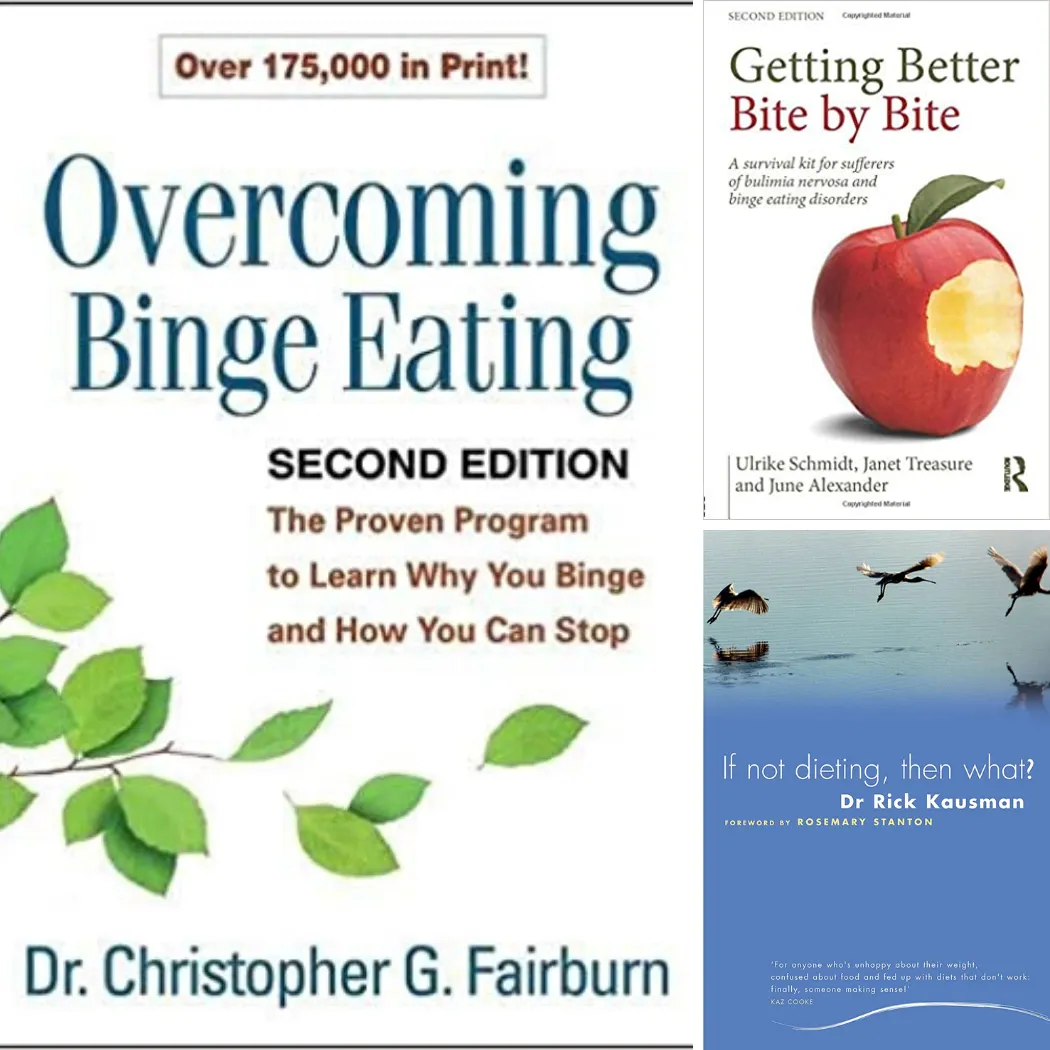
Overcoming Binge Eating (Christopher Fairburn)
Overcoming Binge Eating is, in my opinion, the best self-help book for people struggling with binge eating. The binge eating book contains a psychoeducation component and a structured self-help component, shown to be highly effective. It’s easy to read and follow, and the self-help steps are based on solid evidence.
Getting Better Bite By Bite (Ulrike Schmidt, Janet Treasure, & June Alexander)
Another incredibly useful self-help book for people struggling with bulimia nervosa. Written by arguably two of the most influential eating disorder researchers, this step-by-step self-help book is not only grounded in evidence-based principles, but its warmth, compassion, and understanding towards people with eating disorders is something to applaud.
If Not Dieting, Then What? (Rick Kausmann)
Written be a Melbourne-based medical professional, “If Not Dieting, Then What?” takes a unique approach to helping people address disordered eating by teaching readers about the pitfalls of diet culture and how to properly engage in a sustainable pattern of eating that is guided by internal hunger and satiety cues.
The DBT Solution for Emotional Eating: A Proven Program to Break the Cycle of Bingeing and Out-of-Control Eating (Debra Safer, Sarah Adler & Phillip Mason)
If you’re looking for tools to transform your relationship with food, then this book might just be for you. Grounded in dialectical behavior therapy (DBT), this motivating guide offers a powerful pathway to change. The authors have translated their proven, state-of-the-art treatment into a compassionate self-help resource for anyone struggling with binge eating and other types of stress eating.
Skills-Based Caring for a Loved One with an Eating Disorder (Treasure, Smith & Crane).
Skills-based learning is an excellent resource that will help equip carers with the necessary skills and knowledge needed to support loved ones suffering from an eating disorder. An excellent read to understand how to address those critical barriers that stand in the way of recovery. This book brings a nice mix of empirical research and lived experience to help those fighting an eating disorder.
Eating Disorder Books for Clinicians
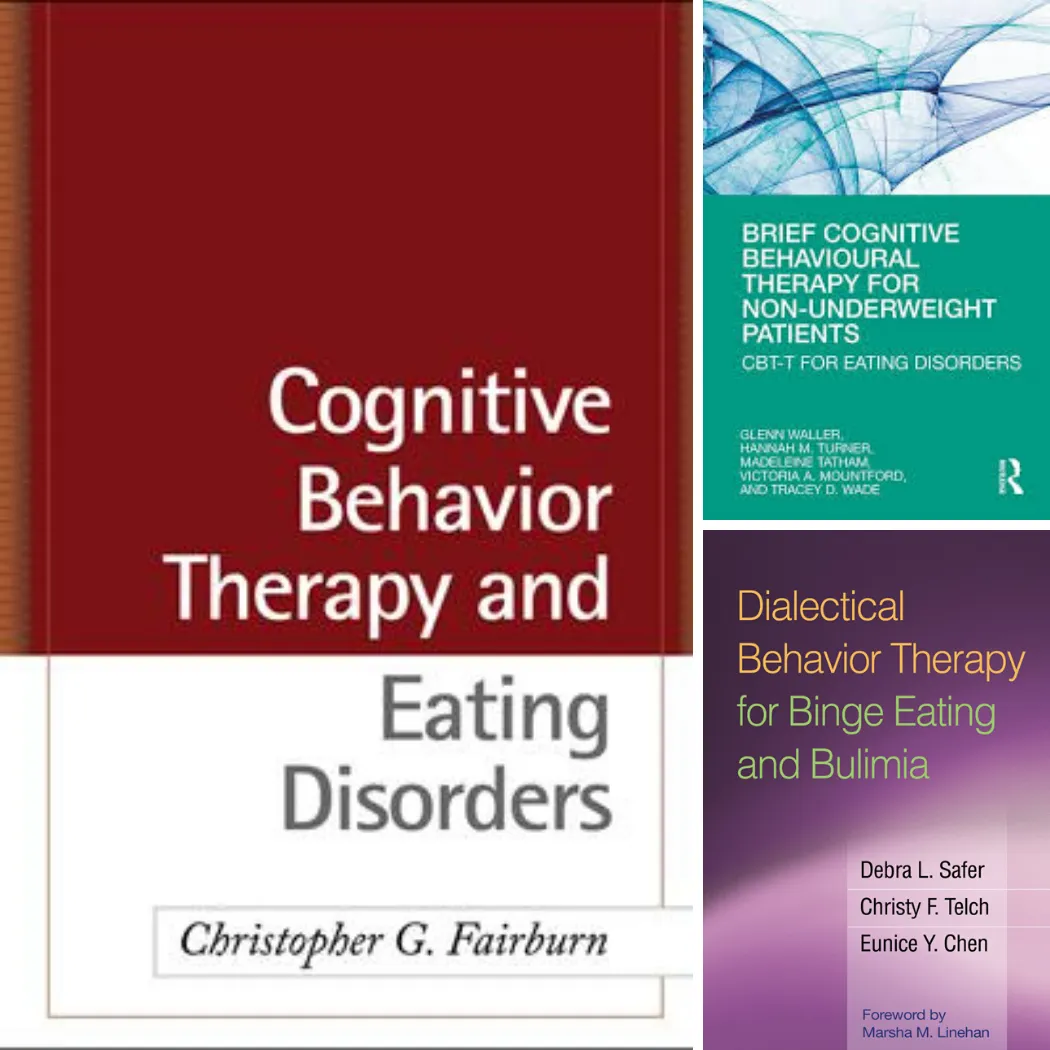
Cognitive Behavior Therapy and Eating Disorders (Christopher Fairburn)
This manual takes a transdiagnostic perspective to the treatment of eating disorders. It’s well-written, easy to follow, and contains practical examples for how best to help you and your clients implement the strategies that underpin CBT. Highly recommended for clinicians wanting to fine-tune their CBT skills for this population group.
Brief Cognitive Behavioural Therapy for Non-Underweight Patients (Glenn Waller, Hannah Turner, Madeleine Tatham, Victoria Mountford & Tracey Wade)
Written by a team of eating disorder experts with a wealth of experience, this book provides an evidence-based protocol that can be delivered by junior or senior practitioners, helping people with an eating disorder to recover and life a fulfilling life. This book will appeal to clinical psychologists, psychiatrists, psychotherapists, dietitians, and nurses.
A Cognitive-Interpersonal Therapy Workbook for Treating Anorexia Nervosa: The Maudsley Model (Ulrike Schmidt, Helen Startup, & Janet Treasure).
This book is based on the authors’ ground-breaking research at London’s Maudsley hospital, providing adults with anorexia nervosa and mental health professionals working alongside them with a practical resource to work through together.
Dialectical Behavior Therapy for Binge Eating and Bulimia Nervosa (Debra Safer, Christy Telch, & Eunice Chen).
This book gives practitioners a new set of tools for helping clients struggling with binge-eating disorder or bulimia nervosa. If you’re looking for case examples, practical handouts, and detailed explanation on how to implement DBT principles, then this book is worth a read.
Eating disorders in boys and men (Jason Nagata, Tiffany Brown, Stewart Murray, & Jason Lavender)
Recognizing that eating disorders often get overlooked in men, this book aims to bring together all of the latest theory, research, and treatments on eating disorders in young boys and men. If you’re wanting to learn more about how eating disorders are expressed in males, what the best treatment approaches are, and why men have traditionally been overlooked, then this book is for you. It’s written by experts who aim to bring more awareness on this important topic.
Treatment Manual for Anorexia Nervosa: A Family-Based Approach (Lock & Le Grange)
This book describes the treatment of family-based therapy (FBT), the leading psychological treatment for anorexia nervosa. Lock and Le Grange are arguably the most influential scientists in FBT, having conducted numerous studies proving this style of treatment to be effective for anorexia nervosa. Any mental health professional who works with clients who present with anorexia nervosa should have a strong understanding of the theory and techniques of FBT, and this book will help with this.
Schema Therapy for Eating Disorders Theory and Practice for Individual and Group Settings (Simpson & Smith)
For clinicians wanting to help clients address deeper personality traits, schema therapy is a suitable option to consider investing time in. There aren’t many reputable books out there to teach professionals how to implement the techniques of schema therapy, but this is one I’d highly recommend. This book draws on the latest evidence, provides clinical case examples, and reviews the theoretical foundations of schema therapy in an organized fashion. Innovative and accessible, this fresh look at the treatment of eating disorders will be an invaluable resource for clinicians in the field.
Biographies
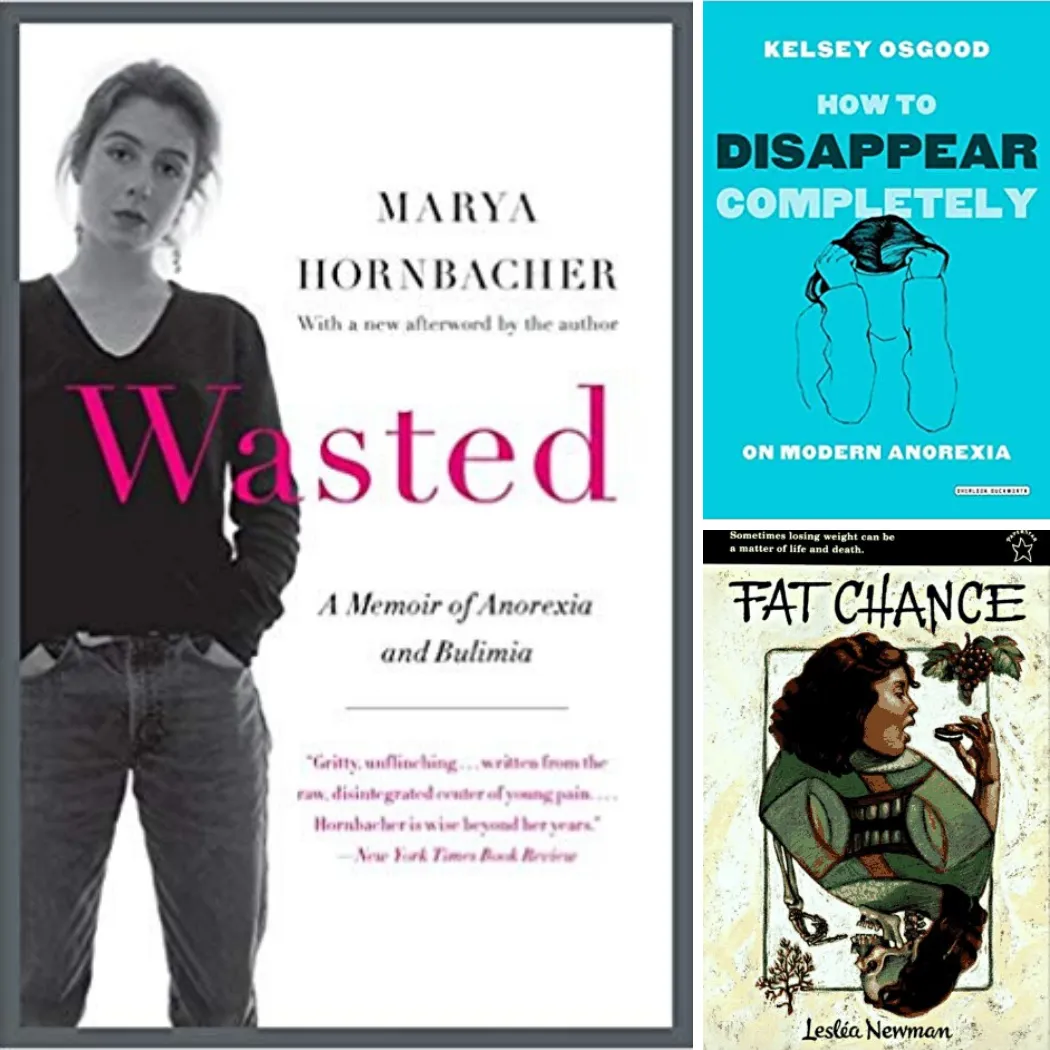
Wasted: A Memoir of Anorexia And Bulimia (Marya Hornbacher)
One of the first bibliographies I had read, Wasted is the story of a women’s long-standing battle with anorexia nervosa, and her decision to fight for recovery. This book paints an excellent picture for what living with an eating disorder is like, and the constant battles faced on a daily basis.
How To Disappear Completely (Kelsey Osgood)
Through her own decade-long battle with anorexia, which included three lengthy hospitalizations, the author describes the haunting and competitive world of inpatient facilities populated with other adolescents, some as young as ten years old.
Fat Chance (Leslea Newman)
Fat chance is an excellent book that describes the life of a young girl who fantasizes of becoming the thinnest girl at school. This fantasy quickly turns to a dark battle towards obsessively controlling her calories, foods, pounds, and bulimia nervosa.
Please Eat…: A Mother’s Struggle To Free Her Teenage Son From Anorexia (Bev Mattocks)
This book takes the perspective of a mother desperately trying to help her son who is battling anorexia nervosa. This inspirational account documents how the mother watched helplessly as her son transformed into someone she didn’t recognize. It also describes how the young boy eventually recovered and re-built his life.
Thin (Grace Bown)
“Thin” is a captivating book that describes the devastating effects of experimenting with new weight loss diets. The eerie details about the lengths a young girl will go to maintain her dangerously low body weight will have you think twice about anorexia nervosa.
What’s Your Favorite Eating Disorder Book?
Did I miss any of your favourite eating disorder books in 2022?
If so, comment below telling me:
Your choice for the #1 best eating disorder book you think we should read
AND
The name of the author.
Discussion (46)
New comments are currently paused. These are comments left by readers before comments were closed. If you are struggling, you can find support on our Help page.
Another recently published bibliography is “Sometimes Life is More Than I can Stomach” (2020). This memoir is very honest and raw, offering a detailed look at what works and what doesn’t when trying to heal from an eating disorder.
Thanks for the suggestion Lina, I’ll add it to my reading list 🙂
Hi, Dr. Linardon. I have someone close to me who struggles with bulemia. Could you please recommend two or three books that you feel are the best on this subject — books that will give me a better idea of what the disease is and what she’s going through. moiradea@gmail.com. If you could send your recommendations to my email as well, I will be certain to get your reply. Thank you.
Hello Moira,
I would recommend the books Overcoming Binge Eating and Cognitive Behavior Therapy and Eating Disorders by Christopher Fairburn. These books closely focus on bulimia nervosa and have demonstrated efficacy for this population.
Hope that helps.
I Can’t Stop Eating by Sarah Dosanjh has been really helpful for me. Her Instagram and YouTube channel have been a great resource during my struggle too.
Thanks for the suggestion Leila!
I will be sure to check those resources out.
View 23 more conversationsShow fewer
Hi Dr. Jake, for a Nutritionist which books do you advice to read for better understanding of eating disorders and helping clients
Hello Alfadhul,
There are many excellent books available.
I am a big fan of the work by Prof Christopher Fairburn, namely “overcoming binge eating” and “cognitive-behavioral therapy and eating disorders”. I think that these books explain key terms very well and contain practical therapy strategies supported by the strongest research designs.
Regards
Jake
I’ve suffered from anorexia and binge eating disorder (or ‘binge eating anorexia’) for 25 years and the only book that has ever truly resonated – and hugely helped – is Brain Over Binge by Kathryn Hansen. The Brain Over Binge Workbook is also great, as is the website and coaching. X
Thanks for the comment Sarah. I have heard a lot about this book. I should definitely invest time in reading this.
I’m glad you found it helpful for yourself.
Me too! I found it very useful during my 20 year (ongoing)
struggle
I loved Happy Fat by Sofie Hagen
Thanks Jaya!
Excellent list! Cognitive Behavior Therapy and Eating Disorders by Christopher Fairburn is my all time favorite. It`s a great help.
My all time favorite too, Anita 🙂
Hi I have written a picture book to help families explain eating disorders to younger siblings. It is called ‘The Disappearing Sister’ (2015). I wrote it after my experience as a mother of a daughter with Anorexia Nervosa with other much younger children in the family.
Thanks for sharing Elizabeth.
Where could I find the book you wrote? My daughter is 18 she has been binge eating then purging and anorexic her BMI was 13 last Dr appt a few months ago. She has refused treatment for 4 years now and asked for help a few months ago I had it all set up we drove 5 hours away and waited for almost two days at Texas children’s to be told policy jyst changed they no longer accept 18 n up (18 to 24 is even still written online) I’d put her in computer insurance all set n that happened then she checked herself in to regular mental hospital she called me sobbing which is rare she said get me out now….I had to fight to get her release for me and AMA for her but now she won’t go to actual great place the only that will do single case agreement with Texas Medicaid. Its in Wisconsin but its the right place. I just turned her toilet off was running constant there’s tums and a whole setup and mess. She’s so sick. I am looking into way to force her to go she can’t think she’s starving to death. The rules for ed make no sense. I have a 6 year old as well. She says sissy is sick and needs love but sissy is often very grouchy mood swings awful. My aunt died heart attack when I was ten btw she was more like my mom it made me remember how she felt when I hug my daughter. She can’t die. She was on slow release potassium but Dr said he’s not trained in ed and can’t prescribe more he’s only done one script….I am so not ok either we have to move again and I can’t save money she’s eating so much n I’m afraid to say no at least maybe some gets in. I can’t let her babysit her sister while I work anymore not safe I was with my aunt alone she went to bathroom and didn’t come out. I want family to go to but there’s none.
I am so sorry to hear what you’re going through with your daughter &that must be so hard for younger sister to understand &deal with. I found the book mentioned in the comment you replied to on Amazon, or just Google “The Disappearing Sister” but here is the Amazon page:
https://www.amazon.com/Disappearing-Sister-dealing-Anorexia-Nervosa/dp/1910667498
I really hope that your daughter has gotten some help &I hope you have been able to find someone like a therapist to talk to! Eating disorders are so hard on the family, like any addiction or mental disorder. Take care of yourself Sarah &I hope your daughter will go into recovery! My heart breaks reading your message &I’m not even a parent.
Thanks for the resources!
Just a comment: bibliography is the list of references used in a piece of text (books or texts that you cite, use…); biography is a narrative of someone’s life.
Thanks for the spot, Andrew! Silly mistake!!
I am actually reading The Binge Eating Prevention Workbook by Gia Marson and Danielle Keenan – Miller .
Thanks for the recommendation! Certainly adding this to my list 🙂
Hello Carol,
I found “In the Labyrinth of Binge Eating” by Hilda Dulin Lee to be very helpful. She was in her 50s by the time she started to recover from her eating disorder.
Kamille
Fantastic, Kamille!
Thanks for your input
I’m currently reading ‘thin side out’. I was put off by the title but it was a recommendation so I got it. I love it so far, I love the use of studies and analogies. It’s easy to read.
That’s great to hear Amy! Thanks so much for sharing!
My granddaughter, Nicole MacIntyre, published a book, at age 15, describing what she was experiencing with her diagnose of anorexia nervosa. I was called, by her parents, to come to their home when she seemed to be out of control. Not until I read her book did I understand, and appreciate, what was going on within her. She named her book Misunderstood, so it would he hard to find as a eating disorder book. But I would strongly recommend this book for family members who deal with a member struggling with this disease. The 190 page paperback is available on Amazon for $10.99.
Thank you! Please do provide the name of the book in a reply for all to see!
I just finished my book 10 Tools for Overcoming Anorexia-Bulimia by Dawn Hightree. It’s on Amazon. Check it out
Congratulations Dawn. I’ll be sure to check it out.
The best eating disorder book for BED I’ve ever read is “Empty” by Susan Burton. I also loved “It Was Me All Along” by Andie Mitchell.
Thanks for sharing Steph!
I read a book in the 1990s that was helpful and I would love to find it again. I remember it had drawings inside and what I got out of it was the idea of negative self talk, like how you can be saying very mean and punishing things to yourself, and the role that plays for a person with an eating disorder. Reading that book wasn’t a cure, but it snapped me out of some element of the disorder. If you have any idea what book that was I’d be grateful.
Hi Kelly,
Unfortunately I’m not sure which book you’re referring to. If it pops in your head, please do let us know!
“Sick enough” by Dr Jennifer Guadiani. Diving deep into medical challenges and at the same time, an understanding of the stories of an ED.
“Brave girl eating” by Harriet Brown. More of a memoir of her daughter’s struggle with anorexia nervosa and family treatment approaches.
“The Eating Instinct” by Virginia Sole-Smith. This book is journalistic in nature and is really interesting talking about ARFID.
and “Nourish” by Heidi Schauster. My go-to self help book. It’s a really helpful, broad exploration into body image, food fixation and so much more.
…these are all books I have found value in (though without your specific – and definitely needed – spotlight on BED).
Hi Dr Jake,
I suffer from Binge eating only. Meaning I don’t have bulimia or anorexia. It seems most of those books are concentrated in one of those two. Any of those books would help if only suffer from BED?
Thank you
Carol
Hi There,
I have someone close to me with a severe eating disorder in their 30s. Do you have any recommendations for them? Any relatable memoirs in the adult age group?
I am actually reading The Binge Eating Prevention Workbook by Gia Marson and Danielle Keenan – Miller .
I’m curious if you have any feedback on the book series from Glenn Livingston. I’ve just started “Never Binge Again” and the recurring theme in managing the urge to binge is to see your binge voice as your inner pig. It’s an interesting idea – but I can understand why it would also seem to a lot of people struggling with negative self talk, that this might feel uncomfortable. I’m curious if you have an opinion on his work and approach. Or anyone else who may have tried it.
Reclaiming body trust by Hilary Kinavey and Dana Sturtevent had been key on my healing journey . I highly recommend it to everyone.
I want to add the book ‘The Wisdom of your body’ from Hillary McBride. It’s less about eating disorders (but she as well recovered from anorexia nervosa) and more about strategies to feel embodied and to experience your body in a different way than just weight & ED. It really helped me to reconnect woth my body and sustain a more loveable thinking about my body.
The Longest Match: Rallying to Defeat an Eating Disorder in Midlife
Hi Dr.Jake, can you recommend some self help books talking about CBT for BED? I can see the one for clinician on the list but is there any one for the patient? Thank you.
Great list! As someone who has struggled with disordered eating for many years, I can attest to the impact that these books have had on my healing journey. I’ve found so much comfort and insight in reading about the experiences of others who have gone through similar struggles. Thank you for sharing this list – I’m excited to dive into these resources and continue on my path to recovery.
An excellent book that I recommend is “Food Junkies” by Dr. Vera Tarman. She is an experienced addictions doc who was herself quite overweight at one time. She uses the treatment techniques she used with alcoholics and drug addicts to treat food addiction. Food addiction is not in the DSM yet but I believe it will be in my lifetime. It was life changing for me. I found out why I couldn’t stop eating and what to do about it. Hint – the answer is NOT another diet.