
Vyvanse (lisdexamfetamine) is approved for adults with moderate-to-severe binge-eating disorder (BED), and in trials it reduced binge eating more than placebo did. It is a stimulant with real medical risks, so psychological treatment such as cognitive behavioral therapy (CBT) is still the recommended first step.
Psychological treatment helps many people with BED, but not everyone responds fully, and some people keep binge eating often despite it. Medication is another way to reduce binge eating. It isn’t right for everyone, and questions remain about how long treatment should last and what happens when it stops.
This page covers what Vyvanse is, how well it works, how it compares with CBT, its risks, and what we know about stopping it.
What is Vyvanse, and how does it work?
Vyvanse is the brand name for lisdexamfetamine, a prescription stimulant that acts on the central nervous system. It was first approved in 2007 to treat attention-deficit/hyperactivity disorder (ADHD). Researchers have since studied it for binge eating.
After you swallow it, your body converts lisdexamfetamine into dextroamphetamine. This raises the activity of brain chemicals including dopamine and norepinephrine, which are involved in attention, motivation, reward and behavioral control. The exact way it reduces binge eating isn’t known. Researchers think it may change how rewarding food feels, increase feelings of fullness, or improve control over impulsive eating.
A small experiment tested this in 22 women with binge-eating symptoms. A single dose of Vyvanse lowered their appetite and food intake and improved sustained attention. These women hadn’t been diagnosed with BED.
Vyvanse acts on brain chemistry. It doesn’t work on the thoughts and habits that CBT targets, and those also keep binge eating going.
Is Vyvanse approved for binge-eating disorder?
Yes. Vyvanse is approved for moderate-to-severe BED in adults in the United States and Australia.
The US Food and Drug Administration (FDA) approved Vyvanse for BED in 2015. The label lists BED as a separate use from ADHD. In Australia, the Therapeutic Goods Administration (TGA) approves Vyvanse for adults with moderate-to-severe BED when non-drug treatment hasn’t worked or isn’t available, and a psychiatrist should start and manage treatment. Vyvanse isn’t approved for BED in people under 18.
Vyvanse isn’t approved or recommended for weight loss. The FDA label says it isn’t indicated for weight loss and that its safety and effectiveness for treating obesity haven’t been established.
How well Vyvanse works
In an 11-week US trial of 255 adults with moderate-to-severe BED, about 21% of people taking placebo went four weeks without binge eating. The figure was about 42% and 50% for the two higher Vyvanse doses tested. The lowest dose tested did no better than placebo on binge days per week.
A 2026 meta-analysis pooled five randomized trials with 988 adults. People taking Vyvanse had about 1.3 fewer binge days a week than people taking placebo, on average. They also had fewer obsessive thoughts and compulsive behaviors around binge eating.
The evidence has limits. The placebo-controlled trials above lasted 11 to 12 weeks, and the longest follow-up phase was six months, so we know more about early effects than long-term ones. A major trial of stopping Vyvanse also excluded people with serious psychiatric or heart conditions, even though depression and anxiety often occur with BED.
Mental health and quality of life
It may help with some of them. In an 8-week open-label study, 41 adults took Vyvanse for BED, and 33 were assessed at week 8.
Eating disorder symptoms and psychological quality of life improved. Depression, anxiety and ADHD symptoms showed no significant change on average.
Because there was no placebo group, the study can’t show that Vyvanse caused the improvements. The authors call the results preliminary.
Is Vyvanse better than cognitive behavioral therapy?
CBT is the leading psychological treatment for BED. It helps people change the thoughts, feelings and behaviors that keep binge eating going.
That usually means building regular eating patterns, loosening rigid food rules, learning ways to handle difficult emotions, and easing excessive concern about body weight and shape. CBT also teaches skills you can keep using after treatment ends. You can read more in our guide to cognitive behavioral therapy.
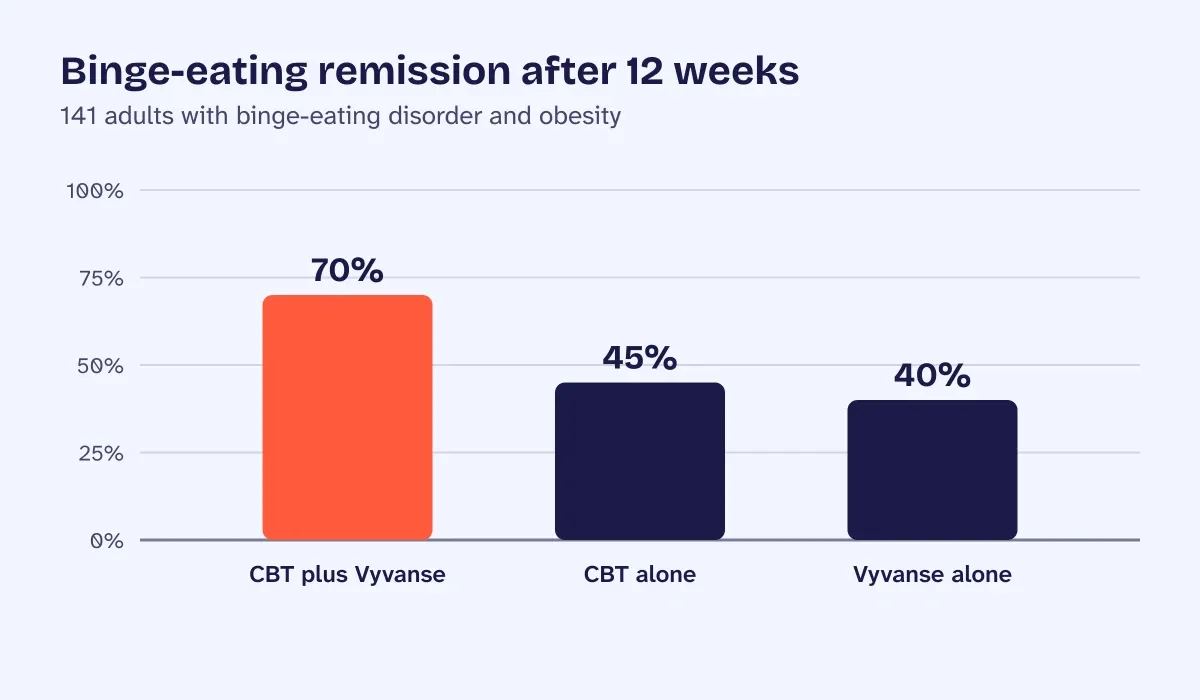
In a 12-week trial at one US center, 141 adults with BED and obesity were assigned to CBT, Vyvanse, or both. Binge eating fell in all three groups, and CBT alone and Vyvanse alone did not differ significantly. Binge-eating remission was 70% with both treatments, 45% with CBT alone and 40% with Vyvanse alone. Adding Vyvanse to CBT may give some people extra short-term benefit.
Why therapy comes first
CBT has been tested in many trials. A 2019 meta-analysis of 81 trials found that CBT-based psychotherapy beat wait-lists for binge episodes and for stopping binge eating. How long the benefits last was poorly studied, and the quality of the evidence was low.
The UK’s NICE guideline recommends guided self-help first, then CBT-based therapy, and advises against using medication as the only treatment. Medication can still have a role. The decision depends on which psychological options are available to you, your circumstances, and how the likely benefits weigh against the risks.
What are the side effects and risks of Vyvanse?
In the two main BED trials, the most common side effects were dry mouth, trouble sleeping and reduced appetite. Dry mouth affected 36% of people on Vyvanse and 7% on placebo. Trouble sleeping affected 20% and 8%, and reduced appetite 8% and 2%.
A faster heart rate, feeling jittery, constipation and anxiety were also more common than on placebo. The 2026 meta-analysis also found more diarrhea with Vyvanse. About 5% of adults taking Vyvanse stopped because of side effects, compared with about 2% on placebo.
Stimulants raise blood pressure and heart rate on average, so a doctor checks your heart health before prescribing. The label also carries a boxed warning that Vyvanse has a high potential for abuse and misuse, which can lead to addiction. Vyvanse commonly reduces appetite, so tell your doctor if you have restricted your eating or have a history of doing so.
Vyvanse needs a medical assessment and ongoing monitoring. A prescribing doctor weighs your physical health, mental health history and other medications, then decides whether the likely benefits outweigh the risks.
What happens when someone stops taking Vyvanse?
Research gives mixed answers. In one trial, 275 people who had responded to 12 weeks of Vyvanse were randomized to keep taking it or switch to placebo. Over the next 26 weeks, binge eating returned for 3.7% of those who kept taking Vyvanse and 32.1% of those switched to placebo.
A more recent 12-week trial followed 61 adults who had already improved on earlier treatment. Relapse was 10.0% with Vyvanse and 17.9% with placebo, a difference that was not statistically significant. The trial was small, and people on Vyvanse did better on some other measures.
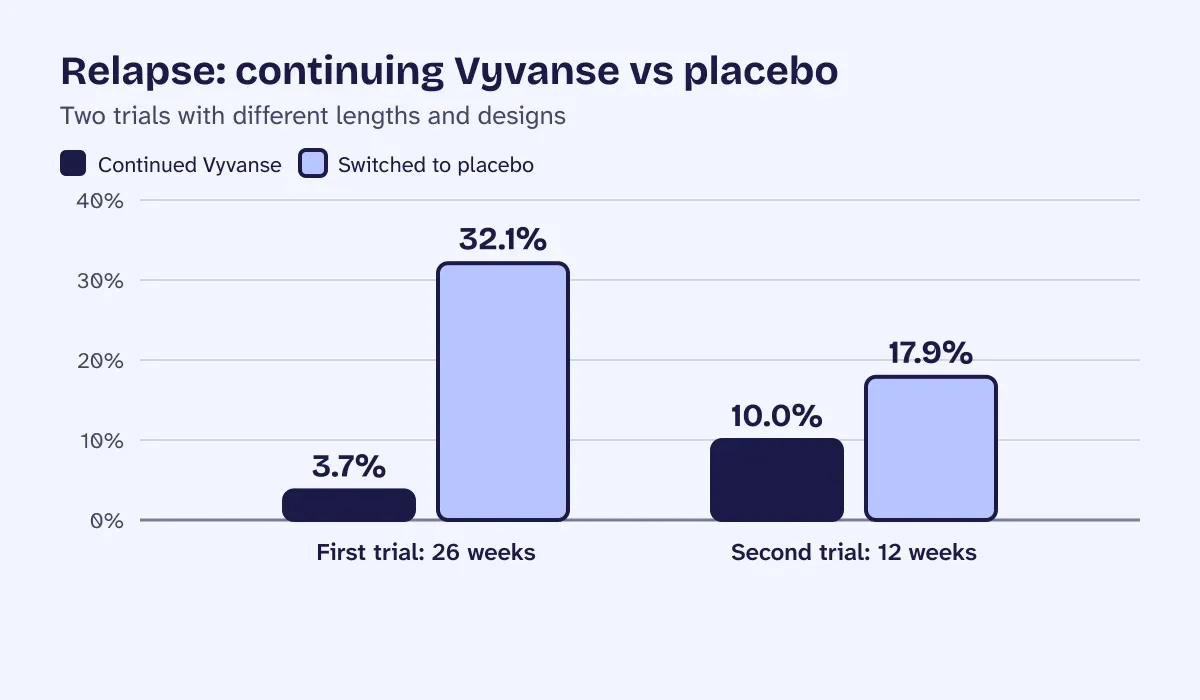
Relapse after continuing Vyvanse or switching to placebo. The two trials differ in length and design.
These results suggest the long-term value of staying on Vyvanse may depend on the person and the treatment they had before.
Can you take Vyvanse for BED without having ADHD?
Yes. The label lists BED as a separate use, so an ADHD diagnosis isn’t part of the approved BED use.
Having BED doesn’t mean Vyvanse is right for you, though. A doctor has to assess your diagnosis, how severe your symptoms are, what treatment you’ve already had, your medical history and the risks before deciding.
Common questions
Is Vyvanse FDA-approved for binge-eating disorder?
Yes. The FDA approved Vyvanse for moderate-to-severe BED in adults in 2015, and the label lists it as a separate use from ADHD.1,4 In Australia, the TGA has approved it for adults with extra conditions.5
Can teenagers or children take Vyvanse for binge-eating disorder?
No. Vyvanse is approved for BED in adults only. The FDA label says its safety and effectiveness for BED haven't been established in people under 18.1 Vyvanse is approved for ADHD in children 6 and older, which is a separate use.1
What are the most common side effects of Vyvanse for binge-eating disorder?
In the two main BED trials, the most common side effects were dry mouth, trouble sleeping and reduced appetite. A faster heart rate, feeling jittery, constipation and anxiety were also more common than on placebo.1 About 5% of adults taking Vyvanse stopped because of side effects, compared with about 2% on placebo.1 Tell your prescriber about any side effects before you change or stop your medication.
How is Vyvanse different from other ADHD stimulants?
Vyvanse is a prodrug, which means it is inactive until your body converts it to dextroamphetamine after you swallow it.1 Its BED approval rests on trials of lisdexamfetamine itself.1 Two common ADHD stimulants, Adderall XR and Concerta, are approved for ADHD only.14,15 Whether another stimulant would suit you is a question for a prescribing doctor.
What else is used to treat binge-eating disorder?
Psychological treatment comes first. NICE recommends guided self-help, then CBT-based therapy.12 The American Psychiatric Association recommends CBT or interpersonal therapy. It suggests an antidepressant or lisdexamfetamine for adults who prefer medication or haven't responded to psychotherapy alone, based on low-quality evidence.16 A 2026 analysis of 12 placebo-controlled trials found that, compared with placebo, topiramate reduced binge eating about as much as Vyvanse did, but topiramate isn't approved for BED.17,18 Our guide to other medications for binge eating covers the options. See also GLP-1 medications and binge-eating disorder.
When to get help
Talk to a doctor if binge eating is frequent, causes distress or gets in the way of daily life, and before you start, change or stop any medication. For support options, see the Help page.
Next step
Read about other medications for binge eating.
Footnotes
US Food and Drug Administration. Vyvanse (lisdexamfetamine dimesylate): prescribing information. Revised April 2026. https://www.accessdata.fda.gov/drugsatfda_docs/label/2026/021977s052lbl.pdf ↩ ↩2 ↩3 ↩4 ↩5 ↩6 ↩7 ↩8 ↩9 ↩10 ↩11 ↩12 ↩13
Schneider E, Higgs S, Dourish CT. Lisdexamfetamine and binge-eating disorder: a systematic review and meta-analysis of the preclinical and clinical data with a focus on mechanism of drug action in treating the disorder. Eur Neuropsychopharmacol. 2021;53:49-78. doi:10.1016/j.euroneuro.2021.08.001 ↩
Schneider E, Martin E, Rotshtein P, et al. The effects of lisdexamfetamine dimesylate on eating behaviour and homeostatic, reward and cognitive processes in women with binge-eating symptoms: an experimental medicine study. Transl Psychiatry. 2022;12:9. doi:10.1038/s41398-021-01770-4 ↩
Shire. Press release on the FDA approval of Vyvanse for binge eating disorder in adults. January 30, 2015. https://www.takeda.com/newsroom/shire-news-releases/2015/vyvanse-lisdexamfetamine-dimesylate-capsules-cii-becomes-first-and-only-treatment-approved-by/ ↩
Therapeutic Goods Administration. Vyvanse (lisdexamfetamine dimesilate), Shire Australia Pty Ltd: prescription medicine registration, indication for binge eating disorder in adults. https://www.tga.gov.au/node/556165 ↩ ↩2
McElroy SL, Hudson JI, Mitchell JE, et al. Efficacy and safety of lisdexamfetamine for treatment of adults with moderate to severe binge-eating disorder: a randomized clinical trial. JAMA Psychiatry. 2015;72(3):235-246. doi:10.1001/jamapsychiatry.2014.2162 ↩ ↩2 ↩3
Prätzel Ellwanger M, Pomianoski BW, Vieira DL, et al. Efficacy, safety and tolerability of lisdexamfetamine dimesylate treatment compared with placebo in adults with binge-eating disorder: a systematic review and meta-analysis of randomised controlled trials. Eur Eat Disord Rev. 2026;34(3):770-779. doi:10.1002/erv.70070 ↩ ↩2 ↩3
Hudson JI, McElroy SL, Ferreira-Cornwell MC, Radewonuk J, Gasior M. Efficacy of lisdexamfetamine in adults with moderate to severe binge-eating disorder: a randomized clinical trial. JAMA Psychiatry. 2017;74(9):903-910. doi:10.1001/jamapsychiatry.2017.1889 ↩ ↩2 ↩3 ↩4
Griffiths KR, Boulet S, Barakat S, et al. Exploring bi-directional impacts of lisdexamfetamine dimesylate on psychological comorbidities and quality of life in people with binge eating disorder. J Eat Disord. 2024;12:80. doi:10.1186/s40337-024-01041-9 ↩ ↩2
Grilo CM, Ivezaj V, Tek C, et al. Cognitive behavioral therapy and lisdexamfetamine, alone and combined, for binge-eating disorder with obesity: a randomized controlled trial. Am J Psychiatry. 2025;182(2):209-218. doi:10.1176/appi.ajp.20230982 ↩ ↩2 ↩3
Hilbert A, Petroff D, Herpertz S, et al. Meta-analysis of the efficacy of psychological and medical treatments for binge-eating disorder. J Consult Clin Psychol. 2019;87(1):91-105. doi:10.1037/ccp0000358 ↩
National Institute for Health and Care Excellence. Eating disorders: recognition and treatment. NICE guideline NG69. Published May 23, 2017; updated December 16, 2020. https://www.nice.org.uk/guidance/ng69/chapter/Recommendations ↩
Grilo CM, Ivezaj V, Yurkow S, et al. Lisdexamfetamine maintenance treatment for binge-eating disorder following successful treatments: randomized double-blind placebo-controlled trial. Psychol Med. 2024;54(12):3334-3344. doi:10.1017/S003329172400148X ↩ ↩2 ↩3